

Self-Care Feels Impossible? Start Here, Mom
When Self-Care Feels Impossible? Start Here, Mom starts to feel like too much, I see you. I am you.
Right now, as I type this, there is a cold cup of coffee sitting three inches from my hand. It has been reheated twice. There is a crusty patch of oatmeal on my sleeve, and if I’m being completely honest, I haven’t brushed my hair since Tuesday.
I am writing this from the trenches because if I hear one more person tell me to ‘just take a bubble bath’ or ‘wake up before the kids to meditate,’ I might actually scream into a sofa cushion. When you are deep in the throes of motherhood—when the noise is constant, the demands are relentless, and your body feels like it doesn’t even belong to you anymore—the very concept of ‘self-care’ feels like just another item on a never-ending to-do list. It feels like a performance.
It feels, quite frankly, impossible.
It’s that heavy, visceral weight in your chest when the toddler starts crying for the fourteenth time before 9:00 AM. It’s the sensory overload of the television blaring, the dog barking, and the sticky texture of juice on the floor that you just cleaned. Your nervous system is screaming ‘fight or flight,’ but you have nowhere to run and no one to fight.
So you freeze. You shut down. You scroll on your phone for twenty minutes in a daze, feeling guiltier with every swipe.
If this is where you are, please know: you aren’t failing. You are overstimulated, under-supported, and biologically tapped out. This isn’t a guide on how to ‘pamper’ yourself.
This is a survival manual for your spirit.

Why Self-Care Feels Impossible? Start Here, Mom Feels So Heavy
We need to talk about why you feel this way. It isn’t because you’re ‘not organized enough’ or because you ‘lack discipline.’ It’s because your nervous system is being bombarded. As a mother, you are the primary regulator for everyone else in the house. When the kids are melting down, your brain is hardwired to respond to those distress signals. Your cortisol levels spike. You are in a state of hyper-vigilance, constantly scanning for the next ’emergency.’ When you live in this state for months or years, your brain stops being able to distinguish between a minor spill and a life-threatening threat. Everything feels like a 10/10 emergency.
This is why ‘self-care’ feels like a joke. How can you relax in a tub when your ears are still ringing with the ghost-echoes of ‘Mommy, Mommy, Mommy!’? Your body is physically unable to enter a state of rest because it doesn’t feel safe. It feels like it needs to stay ‘on’ to ensure everyone survives. This is called ‘functional freeze.’ You’re moving, you’re making lunches, you’re folding laundry, but inside, you’re numb. To start caring for yourself, we have to stop trying to ‘fix’ your schedule and start trying to soothe your nervous system. We have to move from ‘doing more’ to ‘being safe’ in your own skin.

What Makes Self-Care Feels Impossible? Start Here, Mom Build Up So Fast
Let’s be real about what works and what is just ‘Pinterest-pretty’ fluff. We need tools that work when the house is falling apart, not tools that require a babysitter and a $100 budget.
| The ‘Expert’ Advice | The Real-Life Mom Version | Why It Actually Works |
|---|---|---|
| Take a long, relaxing bubble bath | Locking the door for 3 minutes of silence | Lowers sensory input immediately |
| Go to a 60-minute yoga class | Pushing your heels into the floor while standing | Grounds the nervous system in seconds |
| Journal your feelings for 20 mins | A 30-second ‘vent’ text to a trusted friend | Relieves the pressure of ‘carrying it alone’ |
| Wake up at 5:00 AM to meditate | Staying in bed 5 mins longer to just breathe | Prevents the ‘shock’ of immediate service |
| Get a full body massage | Splashing freezing cold water on your face | Resets the vagus nerve instantly |
| Go on a weekend girls’ trip | A ‘Connection Meltdown’—crying it out | Releases pent-up emotional energy |
| Listen to a self-help podcast | One song that makes you feel like ‘You’ | Reconnects you to your pre-mom identity |
| Meal prep healthy salads | Eating the crusts/scraps without guilt | Honoring your basic need for fuel now |
| Digital detox for a week | Putting the phone in a drawer for 10 mins | Reduces ‘scroll-coma’ and eye strain |
| Start a new hobby | Deep humming while doing the dishes | Vibrational soothing for the throat/chest |

The ‘Micro-Internal-Reset’ Framework (How to Start When You Have Nothing)
I developed this framework because I needed something that didn’t require me to leave the room. I call it the **S.T.O.P. & S.I.N.K.** method. It takes less than sixty seconds, and you can do it while your kids are playing (or fighting) right in front of you. This isn’t about ignoring them; it’s about anchoring yourself so you don’t drift away in the storm.
Step 1: S – Scan for Sensation. Instead of focusing on the noise ‘out there,’ turn your attention inward. Where is the tension? Is it in your jaw? Your shoulders? Your gut? Just noticing it takes the power away from the ‘unseen’ stress. You aren’t ‘angry’; your jaw is tight. There is a difference.
Step 2: T – Total Exhale. We often hold our breath when we’re stressed. Take one deep breath in, but focus entirely on the exhale. Make it long. Make it audible. Blow the air out like you’re blowing through a tiny straw. This tells your brain, ‘We are not being chased by a predator. We can exhale.’
Step 3: O – Orient to the Room. Look around. Find three things that are a specific color, like blue. The blue toy, the blue shirt, the blue pen. This pulls your brain out of the emotional ‘amygdala hijack’ and back into the logical prefrontal cortex. It reminds you that you are here, in this moment, and you are safe.
Step 4: P – Physical Pressure. Give yourself a ‘firm’ touch. Cross your arms and squeeze your biceps, or push your palms together hard. This proprioceptive input helps your brain ‘find’ your body again after being ‘touched out’ all day.
Step 5: S.I.N.K. – Sink into the Support. Whatever you are sitting or standing on—the chair, the floor, the sofa—consciously feel it holding you. You spend all day holding everyone else up. For ten seconds, let the floor hold you. Let your weight sink into it. You don’t have to carry the world for these ten seconds.
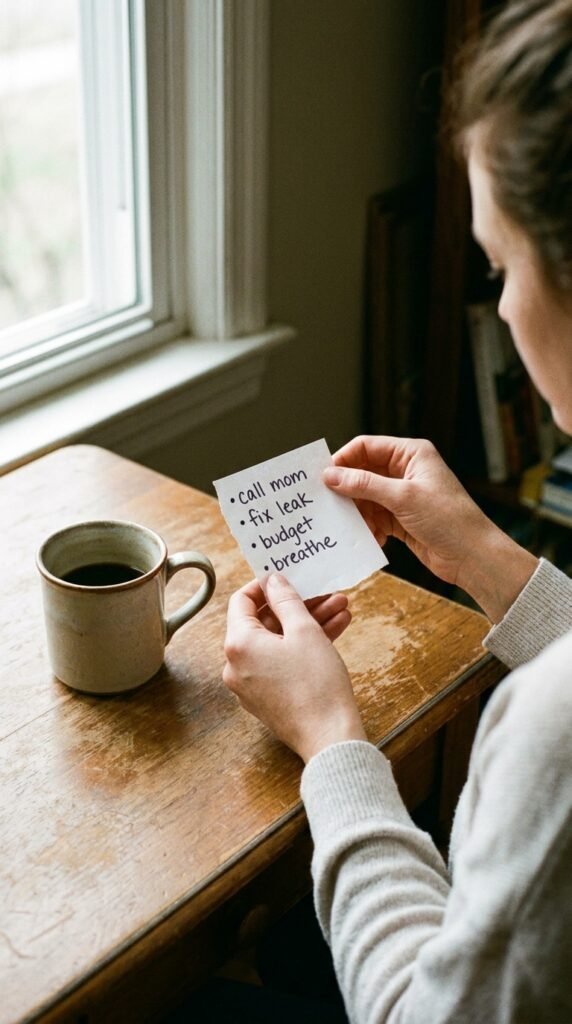
Real Life Scenarios: Why It’s Never Perfect
Scenario 1: Ania and the ‘Morning From Hell.’ Ania’s toddler woke up at 5:15 AM. By 8:00 AM, the milk had spilled, the dog had tracked mud in, and she felt like she was vibrating with rage. Instead of ‘trying to be positive,’ Ania went into the bathroom, turned on the cold tap, and submerged her hands up to the wrists for 30 seconds. She didn’t come out ‘happy,’ but she came out ‘regulated.’ She was able to clean the milk without screaming. That is a win.
Scenario 2: Kasia and the ‘Working Mom Guilt.’ Kasia works from home. She felt like she was failing at her job and her parenting. Her ‘self-care’ was trying to wake up early to work out, which just made her more tired. She swapped the workout for a ‘transition ritual.’ When she closes her laptop, she puts on one specific song and dances (or just sways) for three minutes before opening the office door. It creates a ‘buffer’ between ‘Boss Kasia’ and ‘Mom Kasia.’
Scenario 3: Maria and the ‘Invisible Load.’ Maria is a stay-at-home mom who felt like her brain was ‘mush.’ She couldn’t remember the last time she did something for herself. Her ‘start’ wasn’t a spa day; it was a ‘pantry pause.’ Every afternoon, she goes into the pantry for two minutes, eats one piece of high-quality chocolate, and just breathes. It sounds small, but it’s the only time in her day where she isn’t ‘serving.’ It’s a boundary, and boundaries are the highest form of self-care.

10 Physical Resets for the Mom in Chaos
When your brain is fried, don’t try to ‘think’ your way out of it. Use your body. These are ‘bottom-up’ approaches to calm.
- The Ice Cube Trick: Hold an ice cube in your hand until it melts. The intense cold forces your brain to focus on the sensation, breaking a spiral.
- The Vagus Hum: Close your mouth and hum as deeply as you can. Feel the vibration in your chest. This stimulates the vagus nerve, which tells your body to relax.
- Wall Pushes: Find a sturdy wall and push against it with all your might for 10 seconds. It releases pent-up ‘fight’ energy.
- Heel Drops: Stand on your tiptoes and drop hard onto your heels. The jolt helps ‘reset’ the nervous system.
- The ‘Wet Dog’ Shake: Shake your arms, legs, and head vigorously for 15 seconds. Animals do this to release adrenaline after a threat; humans should too.
- Peripheral Vision: Soften your gaze and try to see the edges of the room without moving your eyes. This triggers the parasympathetic nervous system.
- The Ear Massage: Gently rub the outer edges and lobes of your ears. There are many nerve endings here that promote relaxation.
- Weighted Compression: If you feel ‘floaty’ or anxious, put a heavy pillow or a laundry basket on your lap for a few minutes.
- Temperature Shift: Step outside into the cold air or stand in front of an open fridge for a moment. The sudden change in temperature breaks the ‘freeze’ state.
- The ‘Vu’ Breath: Similar to humming, exhale while making a ‘Voooooo’ sound. It’s like a massage for your internal organs.
Frequently Asked Questions (Mom-to-Mom)
Q: Why do I feel guilty the second I try to do something for myself?
Because you’ve been conditioned to believe that your value lies in your sacrifice. Guilt is just a feeling, not a fact. It’s actually a sign that you are breaking an old, unhealthy pattern. Keep going.
Q: What if I literally have zero minutes of alone time?
Then we don’t look for ‘alone time.’ We look for ‘internal time.’ You can do the S.T.O.P. method while holding a baby. You can do the Vagus Hum while driving. Self-care is an internal state, not a destination.
Q: Why doesn’t a shower feel like self-care to me?
Because a shower is basic hygiene. Calling a shower ‘self-care’ is like calling ‘breathing’ a hobby. If it feels like a chore, it’s not care. Care should feel like a ‘return to self,’ not a maintenance task.
Q: I feel so angry all the time. Is that normal?
Yes. ‘Mom rage’ is usually just a symptom of unmet needs and boundary violations. Your anger is a messenger telling you that you are tapped out. Don’t suppress it—listen to what it’s asking for (usually: less noise, more help, or a break).
Q: How do I explain this to my partner?
Stop asking for ‘help’ and start asking for ‘coverage.’ Say: ‘My nervous system is overstimulated and I need 10 minutes of zero-input time to be a functional parent. Can you take over the kids so I can reset?’
Q: Is it okay if my ‘self-care’ is just scrolling on my phone?
It’s okay, but be careful. Scrolling is often ‘numbing,’ not ‘charging.’ If you feel more tired after scrolling, it’s not working. Try 5 minutes of silence first, then the phone.
Q: How do I stop the ‘touched out’ feeling?
Proprioceptive input (firm pressure) can help. Also, changing your clothes can create a physical ‘boundary’ between you and the sticky hands that have been on you all day.
Q: What if I’m too tired to even try these resets?
Then just lie on the floor. Don’t do anything. Just let the floor hold you. That is enough for today.
The Honest Truth: You Are Not a Problem to Be Solved
We need to have a heart-to-heart, Mama. For so long, the world has told us that if we just ‘optimized’ our lives better, if we just had the right planner or the right morning routine, we wouldn’t feel this way. They treat motherhood like a puzzle to be solved. But you are not a problem to be solved. You are a human being having a very normal response to a very intense season of life. The reason self-care feels impossible is that you are trying to use ‘peace-time’ tools in a ‘war-zone’ environment. You can’t ‘spa’ your way out of burnout, but you can ‘breathe’ your way through the next five minutes.
I want you to lower the bar. No, lower it more. Even more. If all you did today was keep the kids alive and manage not to shatter into a million pieces, you are doing a spectacular job. The ‘Start Here’ part of this guide isn’t about adding a new habit. It’s about removing the expectation that you should be ‘thriving’ right now. Thriving is for later. Right now, we are focusing on *tending.* Tending to the fire so it doesn’t go out. Tending to the woman who exists underneath the ‘Mom’ label. She is still there, I promise. She’s just buried under a pile of laundry and a lot of noise.
From one tired mom to another: you are allowed to be ‘done.’ You are allowed to hate the hard parts. You are allowed to take up space and have needs that aren’t being met by your children. Tonight, when the house finally goes quiet, don’t rush to clean the kitchen.
Don’t rush to fold the clothes. Sit for five minutes in the dark. Don’t check your phone.
Just sit and remind yourself: ‘I am here. I am me. I did my best, and that has to be enough.’ Because it is enough.
You are enough. Let’s stop trying to be perfect and start trying to be kind to ourselves instead. You’ve got this, even on the days when it feels like you don’t.
Now, go take one long, loud exhale. You’ve earned it. Learn more: morning routine. Learn more: morning routine. Learn more: morning routine.
Learn more: morning routine.